
How to Install a 20,000 USG Septic Tank in the UAE: Step-by-Step Guide
Meta Description: How to install a 20,000 USG GRP underground septic tank in the UAE: site checks, excavation, base, lifting, connections, backfilling and commissioning, with the tank's dimensions.
Target Keyword: How to Install a 20000 USG Septic Tank Secondary Keywords: 20000 usg septic tank, 20000 gallon septic tank installation, large underground septic tank uae, grp septic tank installation, septic tank for labour camp
A 20,000 USG septic tank holds about 75,700 litres and is one of the largest GRP septic tanks used in the UAE, typically for labour camps, industrial sites and large developments with no mains sewer connection. At more than 12 metres long, it is installed very differently from a villa tank. This guide walks through the full installation, from checking the site to commissioning, using the dimensions of the Khazzan 20,000 USG tank.
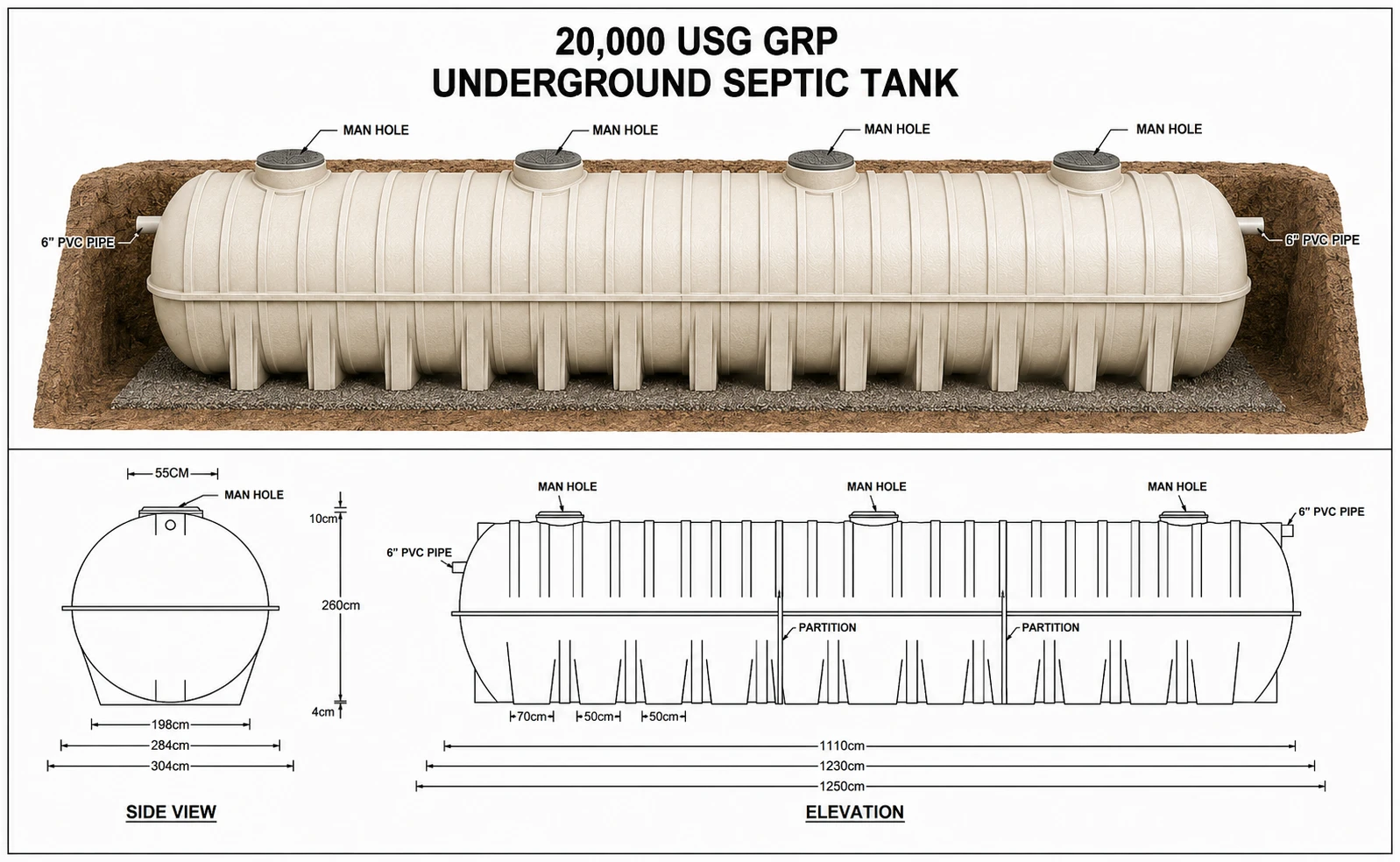
This is a general guide. Always follow your project engineer's design, the manufacturer's instructions, and the requirements of your emirate's municipality. Installation should be carried out by an experienced contractor.
20,000 USG Tank at a Glance
| Item | Value |
|---|---|
| Capacity | 20,000 USG (about 75,708 litres) |
| Overall length | 1,250 cm (1,230 cm at the body, 1,110 cm between the end supports) |
| Overall width | 304 cm (284 cm and 198 cm at the lower levels) |
| Height | 260 cm, plus 10 cm for the manhole neck and 4 cm base |
| Construction | GRP (glass reinforced plastic), ribbed body with support legs |
| Chambers | Divided by internal partitions into several chambers |
| Access | 55 cm manholes over the chambers |
| Connections | 6 inch PVC inlet and outlet pipes |
| Leg spacing | 70 cm, 50 cm and 50 cm sections shown on the drawing |
See the full range of GRP septic tanks, including the 20,000 USG septic tank.
Before You Start: Planning Checks
Most installation problems are decided before any digging starts.
- Municipality approval. On-site wastewater systems normally need approval from the relevant emirate municipality. Confirm the tank location, distances and discharge arrangement before you order.
- Distances. Municipality guidelines typically require clearance from building foundations, boundaries, wells and underground utilities. Confirm the exact distances for your site.
- Sizing. Check that 20,000 USG is the right size for the daily flow, using the occupancy of the camp or facility and the number of days between desludging.
- Soil and groundwater. Get the soil type and the groundwater level for the site. This decides the base, the buoyancy measures and whether dewatering is needed.
- Access and lifting. A tank of this length needs a clear delivery route and a suitable crane position. Plan the lift before the tank arrives.
- Utilities. Locate buried services before excavation.
Step 1: Excavate the Pit
- Size. Excavate larger than the tank on every side to leave working room for backfilling and compaction. The tank is about 12.5 m long and 3.04 m wide, so the pit is large.
- Depth. Allow for the tank height of about 2.6 m, the base bed underneath, and the soil cover over the top. Manhole necks should be brought up to finished ground level.
- Safety. A pit this deep needs sloped sides or shoring, a safe access route, and a plan for keeping people and machinery clear of the edge. Never let anyone work under an unsupported excavation face.
- Groundwater. If water enters the pit, dewater it before placing the base and keep it controlled until the tank is backfilled.
Step 2: Prepare the Base
The tank must sit on a firm, level, uniform base so its weight is carried evenly by the support legs.
- Remove soft spots and stones from the bottom of the excavation.
- Place and compact a bed of clean sand or fine gravel, or cast a reinforced concrete slab where the engineer specifies one (for example in weak soil or where groundwater is high).
- Check the base is level along the full 12 m length. Even a small slope matters on a tank this long.
Step 3: Lift and Position the Tank
- Use a crane of the right capacity with a spreader beam and slings rated for the load. Use the lifting points the manufacturer provides.
- Never drag or roll the tank, and never lift it by the pipes or manhole necks.
- Inspect the tank for damage before lowering it, and again once it is in the pit.
- Lower it slowly onto the base, then check it is level and the inlet and outlet pipes are on the correct ends to suit the incoming and outgoing lines.
Step 4: Anchor Against Buoyancy (If Needed)
An empty underground tank can float if groundwater rises around it, and a 20,000 USG tank has a lot of buoyant force. In areas with a high water table, such as coastal sites, the engineer will usually specify a concrete base slab with hold-down straps over the tank. Do not skip this where groundwater is present. Even on dry sites, keep the tank from being left empty and uncovered during heavy rain while the pit is open.
Step 5: Make the Pipe Connections
- Connect the 6 inch PVC inlet and outlet pipes. Use flexible couplings or an approved flexible arrangement so settlement does not stress the tank connections.
- Lay the inlet and outlet pipework to a continuous fall in the correct direction.
- Leave the connection points accessible until the tank has been tested.
- Fit ventilation. Septic tanks produce gases and need a vent pipe taken to a safe position above ground, away from windows and air intakes.
- Raise each manhole to finished ground level with a suitable access shaft and cover that can be opened for desludging and inspection.
Step 6: Backfill and Fill with Water Together
This is the most important step for a long tank, because uneven backfill or an empty tank can deform the shell.
- Backfill with clean sand or fine gravel, free of large stones, sharp edges and debris.
- Place it in layers, typically around 200 to 300 mm at a time, and compact each layer by hand or light equipment. Do not use heavy compaction machinery against the tank wall.
- Fill around the legs and the lower shell first, so no voids are left under the tank.
- Fill the tank with clean water in step with the backfill, keeping the water level slightly ahead of the soil level. This supports the shell and also guards against flotation.
- Keep the backfill even on both sides so the tank is never loaded from one side only.
- Continue up to the top of the tank, then complete the cover to finished level.
Step 7: Test and Commission
- Check the tank and all connections for leaks while it is full of water.
- Confirm the inlet and outlet flow correctly and the vent is clear.
- Check the manhole covers seal and lock properly.
- Keep heavy vehicles and loads off the tank area unless the installation has been designed for traffic loading.
- Record the installation date and details so that desludging and inspection can be scheduled.
After Installation: Maintenance
A septic tank only works properly if it is emptied and inspected on a regular schedule. Large commercial and labour camp tanks usually need desludging more often than a villa tank, so plan this from the start. See our guide to septic tank cleaning and desludging.
Common Mistakes to Avoid
- Installing on an uneven or soft base
- Ignoring groundwater and leaving an empty tank unprotected
- Backfilling with stones, rubble or dry heavy soil against the shell
- Backfilling without filling the tank with water
- Using heavy compaction equipment right against the tank
- No vent pipe, or a vent that ends near a window
- Leaving the manholes buried below finished ground level
Need a 20,000 USG Septic Tank?
Khazzan supplies GRP septic tanks from 300 to 20,000 USG, plus custom sizes. WhatsApp or call +971509583173 or email khazzanae@gmail.com with your site details for a quotation. Delivery is charged separately and varies by location. See delivery pricing. For non-standard requirements, read about custom vertical septic tanks.
Frequently Asked Questions
Q: How big is a 20,000 USG septic tank? A: It holds about 75,708 litres and is roughly 12.5 m long, 3.04 m wide and 2.6 m high, plus the manhole necks, based on the Khazzan drawing.
Q: Do I need a crane to install a 20,000 USG septic tank? A: Yes. A tank of this size is lifted with a crane using a spreader beam and rated slings, and should never be dragged or rolled.
Q: How deep should a 20,000 USG septic tank be buried? A: The pit must fit the tank height of about 2.6 m, the base bed and the soil cover, so it is deep. The manhole necks should be brought to finished ground level. Your engineer will set the exact depth from the pipe levels and ground conditions.
Q: Do I need a concrete slab under the tank? A: Not always. A compacted sand or gravel bed is common on good soil, while a reinforced concrete slab is often used in weak soil or where groundwater is high. The project engineer decides.
Q: Can an empty septic tank float? A: Yes. If groundwater rises around an empty underground tank it can lift it, which is why high water table sites use a concrete slab with hold-down straps and why the tank is filled with water during backfilling.
Q: Why fill the tank with water while backfilling? A: The water supports the shell from inside as soil pressure builds up outside and helps prevent flotation. Keep the water level slightly ahead of the backfill level.
Q: What should I backfill with? A: Clean sand or fine gravel free of large stones, sharp edges and debris, placed in layers and compacted lightly. Avoid heavy machinery against the tank.
Q: How many chambers does the tank have? A: The tank is divided into several chambers by internal partitions, which improves settlement and treatment compared with a single chamber. Confirm the exact layout against your tank specification.
Q: What size pipes does it use? A: The drawing shows 6 inch PVC inlet and outlet pipes.
Q: Who should install it? A: An experienced contractor, working to the engineer's design and the municipality's requirements. Khazzan can advise on specification and recommend contractors.
Q: How often does a 20,000 USG septic tank need desludging? A: It depends on the daily flow and the number of users. Commercial and labour camp tanks generally need desludging more often than residential ones, so set the schedule at the design stage.
Related Resources
- 20,000 USG GRP Septic Tank
- GRP Septic Tanks UAE, Full Range
- Septic Tank Cleaning UAE
- GRP Fiberglass Septic Tank Lifespan
- Custom Vertical Septic Tanks
- Buy Water Tank UAE, Khazzan.ae
📞 Call or WhatsApp: +971509583173 ✉️ Email: khazzanae@gmail.com 🌐 khazzan.ae 📍 Al Qouz Industrial Area 3, Dubai, UAE 🕐 Monday to Saturday, 8AM to 7PM