How Long Does a GRP Fiberglass Septic Tank Last in UAE?
Meta Description: GRP fiberglass septic tanks last 25 to 50 years in UAE conditions. Learn what affects lifespan, how GRP compares to concrete and plastic, and how to extend your tank's life. Expert guide by Khazzan.
Target Keyword: GRP fiberglass septic tank lifespan UAE
If you're buying a septic tank in the UAE, one of the first questions you'll ask is: how long will it last? It's the right question. A septic tank is an underground structure. Replacing it is expensive, disruptive, and involves re-excavating your property. Getting the lifespan right matters.
The short answer: a properly installed GRP (Glass Reinforced Plastic) fiberglass septic tank in the UAE typically lasts 25 to 50 years. Some installations last longer. The material itself doesn't corrode, doesn't crack from thermal cycling, and doesn't deteriorate from exposure to the biological and chemical environment inside a working septic tank.
This article explains what that lifespan means in practice, what affects it, how GRP compares to the alternatives, and what you can do to get the most out of your tank.

What Is a GRP Fiberglass Septic Tank?
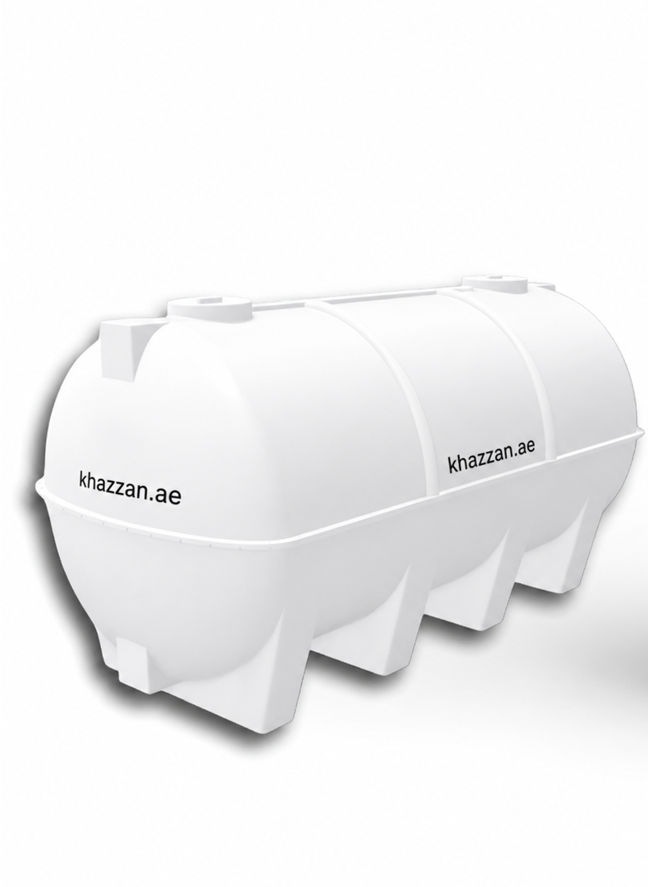
GRP stands for Glass Reinforced Plastic. It is the same material commonly called fiberglass. The tank is manufactured by combining layers of woven glass fibre matting with a polyester or vinyl ester resin. The result is a composite material that is:
- Stronger than steel relative to its weight
- Completely non-corrosive
- Inert to the biological and chemical environment inside a septic system
- Watertight from the moment it leaves the factory
The inner surface of a GRP septic tank is coated with a chemical-resistant resin gel coat. This inner lining protects the structural glass fibre layers from direct contact with wastewater, hydrogen sulphide gas, and anaerobic bacterial activity.
GRP septic tanks are manufactured in the UAE in a wide range of sizes, from 300 USG (1,135 litres) for small villas up to 20,000 USG (75,708 litres) for large industrial facilities and labour camps.
How Long Does a GRP Septic Tank Last in UAE?
A well-installed GRP fiberglass septic tank in the UAE has a service lifespan of 25 to 50 years. This is significantly longer than concrete (which typically lasts 10 to 20 years in UAE soil conditions) and longer than most other septic tank materials used in the region.
Why the Range Is So Wide
The 25 to 50 year range reflects real-world variation based on:
Installation quality: A tank installed on a proper compacted gravel bed, with clean sand backfill, and correct inlet/outlet pipe connections will last far longer than one installed in poorly compacted fill or with rigid connections that create stress points on the tank wall.
Site conditions: UAE groundwater salinity varies considerably. Coastal areas have highly saline groundwater. Inland sites may have more neutral soil chemistry. GRP handles both well, but highly aggressive soils may slightly accelerate any surface degradation on the outer shell.
Maintenance frequency: A tank that is never pumped fills with accumulated sludge. When sludge overflows the outlet, it clogs the soakaway and eventually causes back-pressure inside the tank. Tanks on a proper desludging schedule consistently outlast neglected ones.
Tank quality and resin specification: Not all GRP tanks are equal. The quality of the resin, the thickness of the glass fibre layers, and the consistency of the manufacturing process all affect long-term performance. Always buy from a supplier who can provide manufacturer's documentation.
GRP vs Concrete Septic Tank: Lifespan Comparison
This is the most important comparison for UAE property owners, because concrete septic tanks were the historical standard before GRP became widely available.
| Factor | GRP Fiberglass | Concrete |
|---|---|---|
| Typical lifespan in UAE | 25 to 50 years | 10 to 20 years |
| Hydrogen sulphide resistance | Excellent | Poor |
| Groundwater salinity resistance | Excellent | Moderate |
| Watertightness (factory) | Inherent | Requires coating |
| Watertightness (over time) | Maintained | Degrades as concrete cracks |
| Weight | Light | Very heavy |
| Installation | Fast | Requires significant civil works |
| UAE Municipality preference | GRP specified | Being phased out |
Why Concrete Fails Faster in UAE
The primary reason concrete septic tanks deteriorate much faster than GRP in the UAE is hydrogen sulphide corrosion. Inside a working septic tank, anaerobic bacteria produce hydrogen sulphide (H2S) gas above the liquid level. This gas reacts with moisture in the air space to form sulphuric acid, which attacks concrete aggressively. The process is called microbially induced corrosion (MIC) and it is the leading cause of premature septic tank failure worldwide.
GRP is completely immune to this process. The resin matrix does not react with hydrogen sulphide, sulphuric acid, or any of the other byproducts of anaerobic digestion. This is the single most important reason GRP septic tanks outlast concrete tanks in UAE by a factor of two to three.
Concrete septic tanks also absorb water. Over time, the absorbed water carries dissolved salts into the concrete matrix, which then crystallise and expand as conditions change. UAE groundwater is often highly saline. This salt attack, combined with thermal cycling from UAE's extreme temperature swings, causes cracking and structural deterioration within 10 to 15 years in many UAE installations.
GRP vs Plastic Septic Tank: Lifespan Comparison
Polyethylene (PE) septic tanks are available in smaller sizes, typically up to 2,000 litres. They are cheaper than GRP for small residential applications but have limitations:
| Factor | GRP Fiberglass | Polyethylene (PE) |
|---|---|---|
| Maximum available size | 20,000 USG+ | Typically 500 USG max |
| Underground burial rating | Yes, all sizes | Limited, small sizes only |
| Chemical resistance | Excellent | Good, but lower than GRP |
| Long-term rigidity | High | Can creep under soil pressure |
| Lifespan | 25 to 50 years | 15 to 25 years |
For small septic installations (single villas with low occupancy), polyethylene is a legitimate option. For anything larger, or for any underground installation with significant depth, GRP is the correct material.
What Affects the Lifespan of Your GRP Septic Tank in UAE?
1. Installation Quality
The most common cause of shortened GRP septic tank life in the UAE is poor installation. The key requirements:
Bedding: The tank must sit on a 300 mm compacted layer of clean sand or pea gravel. This provides uniform support under the full base of the tank. Without it, point loading on the base causes stress concentrations that can crack the tank shell over time.
Backfill: Backfill material must be clean sand or pea gravel, not sharp stones, construction rubble, or compacted clay. Stones pressed against the GRP shell by soil pressure create localised stress points.
Pipe connections: Inlet and outlet pipes must connect with flexible couplings, not rigid glued or cemented connections. GRP and the surrounding soil move slightly with temperature changes and settlement. Rigid pipe connections transmit movement stress directly to the tank wall.
Burial depth: The tank must not be over-buried. Follow the manufacturer's specification for maximum cover depth. Exceeding it increases soil pressure beyond the tank's design rating.
2. Regular Desludging (Pump-Out)
The biological process inside a septic tank produces a layer of sludge at the bottom and a layer of scum at the top. The working liquid zone between them is where treatment occurs. Over time, the sludge layer grows. When it fills beyond a certain level, the treatment zone is reduced, effluent quality deteriorates, and eventually sludge passes out through the outlet.
For UAE conditions, most residential GRP septic tanks should be pumped out:
| Property Type | Recommended Pump-Out Frequency |
|---|---|
| Small villa (2-3 bedrooms) | Every 12 to 18 months |
| Large villa (4-6 bedrooms) | Every 6 to 12 months |
| Small commercial / restaurant | Every 3 to 6 months |
| Large commercial / labour camp | Every 1 to 3 months |
Tanks that are never pumped fill with sludge and become essentially holding tanks. The high sludge levels create increased pressure on the tank base and walls. Regular pump-out is the single most impactful maintenance action for extending tank life.
3. What Goes Into the Tank
GRP is chemically resistant, but no material is inert to everything. Some substances shorten septic tank life when discharged into the system:
Cooking fats and oils: These don't digest in a standard septic system. They accumulate in the scum layer and cause system blockage over time. Install a grease trap upstream of the septic tank for commercial kitchens and restaurants.
Bleach and disinfectants in large quantities: Regular household cleaning products are fine in normal quantities. Industrial concentrations of bleach or disinfectant can kill the beneficial bacteria that make the septic system work. Without bacterial activity, the system stops treating waste properly.
Paint, solvents, and chemicals: These can attack the GRP inner liner over time depending on the chemical. Never discharge paint washout, solvent residues, or industrial chemicals into a residential septic system.
4. Groundwater Table
UAE groundwater tables vary considerably. In coastal areas and near creek systems, the groundwater table can be very high. An underground tank experiences buoyancy force equal to the weight of water displaced by the buried tank volume. An empty or lightly loaded tank can experience significant upward flotation force if groundwater rises above the base of the tank.
This is particularly relevant in UAE after heavy rains in winter months. GRP tanks specified for high-groundwater conditions include additional anti-flotation measures such as concrete anchor collars or engineered backfill specifications. If your site has a high groundwater table, specify this to your tank supplier.
Signs Your GRP Septic Tank Needs Attention
Even the most durable septic tank benefits from periodic inspection. Watch for:
Slow drains throughout the property: Indicates the tank is full or the outlet is partially blocked. Arrange pump-out and inspection.
Sewage odours at ground surface: Can indicate a leaking tank, a blocked vent pipe, or high sludge levels. Investigate promptly.
Wet patches or unusually green grass above the tank: Indicates effluent is reaching the surface, either from a leaking tank or a saturated soakaway. This is a health hazard and needs immediate attention.
Gurgling sounds in drain pipes: Usually indicates the soakaway is saturated or the outlet pipe is partially blocked. Often resolved by pump-out.
Water in the manhole at unusually high levels: Indicates either inflow (groundwater entering through a crack or faulty seal) or a blocked outlet.
If you observe any of these signs, have the tank inspected by a professional. GRP tanks are repairable, and catching a problem early is far cheaper than complete tank replacement.
Maintaining Your GRP Septic Tank: Annual Checklist
Every 6 to 12 months:
- Pump out accumulated sludge and scum
- Check inlet and outlet pipe connections for any signs of movement or damage
- Inspect the manhole cover and seal for condition
- Check the ground surface above the tank for any movement or settlement
Every 2 to 3 years:
- Visual inspection of the interior GRP surface (at time of pump-out)
- Check the vent pipe is clear and functioning
- Test soakaway performance if accessible
After heavy rain:
- Inspect manhole for any signs of groundwater inflow
- Check drain performance inside the property
Buying a GRP Septic Tank That Lasts in UAE
Lifespan begins with specification. When buying a GRP septic tank in the UAE:
Ask for UAE Municipality compliance documentation. All GRP septic tanks sold for use in UAE properties should be UAE Municipality compliant.
Ask about the resin specification. For septic applications, vinyl ester inner liners are more chemically resistant than standard isophthalic polyester. They cost more but are worth specifying for commercial or high-use applications.
Ask about wall thickness. Thicker walls mean greater structural integrity for underground burial and longer service life.
Buy from a supplier with technical knowledge. A supplier who can answer questions about resin specification, burial depth ratings, and installation requirements is a supplier whose tanks are worth trusting.
Khazzan supplies GRP fiberglass septic tanks from 300 USG to 20,000 USG across all UAE emirates. All tanks are UAE Municipality compliant, underground burial rated, and come with a 1-year manufacturer's warranty. Our team can advise on the right size and specification for your property.
Frequently Asked Questions
Q: How long does a GRP fiberglass septic tank last in UAE? A: A properly installed GRP fiberglass septic tank in the UAE typically lasts 25 to 50 years. The material is completely resistant to hydrogen sulphide corrosion, UAE groundwater salinity, and the thermal cycling of the UAE climate. Actual lifespan depends on installation quality, maintenance frequency, and site conditions.
Q: Is GRP better than concrete for a septic tank in UAE? A: Yes, significantly. Concrete septic tanks in UAE typically last 10 to 20 years before hydrogen sulphide corrosion and salt attack cause cracking and leakage. GRP is immune to both processes and lasts two to three times longer. UAE Municipality increasingly specifies GRP over concrete for new septic installations.
Q: How often should a GRP septic tank be pumped out in UAE? A: For a residential villa in UAE, pump out every 6 to 18 months depending on occupancy. For commercial properties, every 3 to 6 months. For labour camps and industrial facilities, monthly inspection is recommended. Regular pump-out is the single most important maintenance action for extending tank life.
Q: Can a damaged GRP septic tank be repaired in UAE? A: Yes. GRP is repairable using fiberglass laminate and appropriate resin. Cracks, delamination, and damaged pipe connections can be repaired by qualified GRP contractors in the UAE. Early repair of minor damage prevents it from becoming a structural failure. Always address warning signs promptly.
Q: What size GRP septic tank do I need for my UAE villa? A: For a 3 to 4 bedroom villa in UAE, a 500 to 800 USG (1,893 to 3,028 L) GRP septic tank is the standard specification. For a 5 to 6 bedroom villa, 800 to 1,000 USG. For commercial properties, contact Khazzan at +971509583173 for a sizing assessment based on your daily occupancy.
Q: Where can I buy a GRP septic tank in Dubai? A: Khazzan supplies GRP fiberglass septic tanks across all UAE emirates including Dubai, Abu Dhabi, Sharjah, Ajman, Ras Al Khaimah, and Fujairah. Contact us on WhatsApp at +971509583173 or visit khazzan.ae for the full range from 300 to 20,000 USG.
Q: How do I know if my septic tank needs replacing in UAE? A: Signs that a septic tank needs replacing include: visible structural cracks in the tank body, significant inflow of groundwater even after heavy rain has passed, persistent sewage odours despite regular pump-out and normal usage, and tank age beyond 20 to 25 years for concrete tanks. GRP tanks rarely need full replacement if properly maintained. Contact Khazzan at +971509583173 for an inspection recommendation.
Ready to Buy a GRP Septic Tank in UAE?
Khazzan supplies GRP fiberglass septic tanks from 300 USG to 20,000 USG with fast delivery across all UAE emirates. UAE Municipality compliant, underground burial rated, corrosion-resistant fiberglass construction.
Contact us on WhatsApp at +971509583173 or visit khazzan.ae/products/septic-tanks for the full range, technical specifications, and pricing.
📞 Call or WhatsApp: +971509583173 🌐 khazzan.ae 📍 Dubai, UAE — delivering to all 7 emirates