
GRP Septic Tanks in the UAE: Sizing, Pricing & Installation (2025)
Meta Description: GRP septic tanks for UAE properties off the sewage network. Sizes from 300 to 20,000 US Gallon, pricing, municipality rules, and how installation actually works.
Target Keyword: Septic Tank UAE Secondary Keywords: septic tank Dubai, GRP septic tank UAE, underground septic tank UAE, septic tank price UAE, sewage tank UAE
Plenty of UAE properties simply aren't on the municipal sewage grid — farms out toward Al Ain, labour accommodation on the fringes of Sharjah's industrial zones, villas in newer developments still waiting on infrastructure, and standalone facilities scattered across the emirates. For all of them, a septic tank is doing a job the network isn't: handling wastewater on-site, day in and day out.
Get the sizing and installation right and a septic system will run quietly for years without drama. Get it wrong — undersized, the wrong material, or simply forgotten about — and it turns into a genuinely unpleasant and expensive emergency, usually at the worst possible moment.
GRP (Glass Reinforced Plastic) has become the default material for septic tanks across the UAE, and it earns that position. It shrugs off the heat, resists the corrosive gases that wastewater produces, holds its shape under buried soil load, and doesn't flinch at the chemistry of raw sewage. A GRP septic tank from Khazzan.ae carries a rated 5-year service life and a 1-year manufacturer's warranty.
Below is a practical walkthrough: how the system works, how to size it correctly, what it costs, how installation proceeds, and what UAE municipalities expect from you.
How a Septic System Actually Works
It helps to understand the mechanics before you start thinking about sizes and prices.
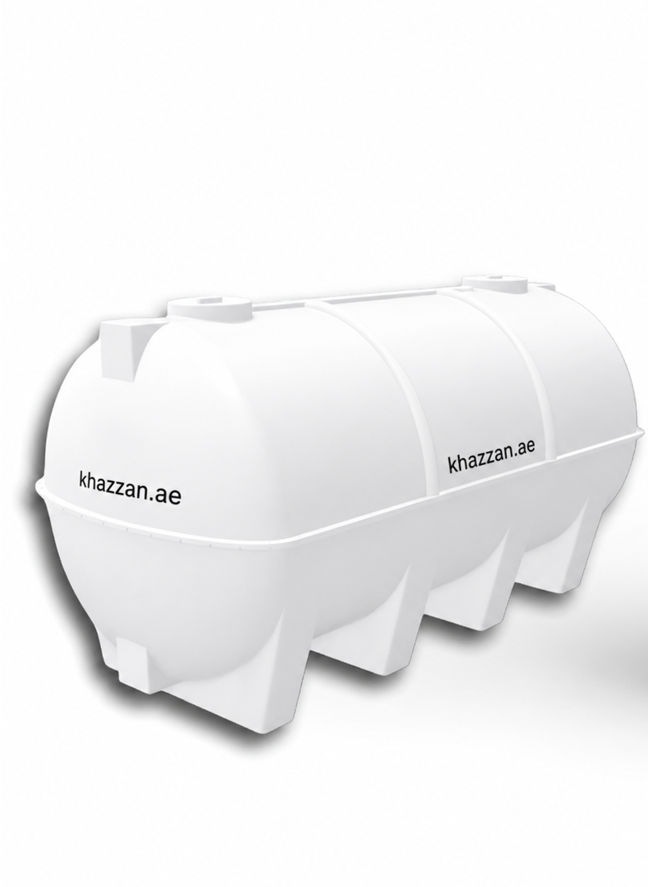
Wastewater enters through the inlet pipe. Once inside, gravity does most of the sorting: solids settle to the bottom as sludge, fats and oils rise to form a scum layer, and the relatively clear liquid in between — the effluent — is what eventually makes its way out through the outlet. Naturally occurring anaerobic bacteria inside the tank continuously break down the settled solids, which is what keeps the system from filling up as fast as you'd otherwise expect.
From there, effluent either drains to a soakaway (where the soil and local regulations allow it) or is removed by a vacuum tanker. Either way, the sludge layer needs periodic pumping out — that part doesn't take care of itself.
One chamber or two? A single-chamber tank does everything in one space. A two-chamber tank — split by an internal baffle — separates the heavy settling stage from a secondary clarification stage, producing cleaner effluent. For villas, labour camps, and most commercial sites in the UAE, two-chamber is worth the modest extra cost.
Why GRP Wins in Septic Applications
Septic environments are genuinely hostile. Hydrogen sulphide gas, a natural by-product of anaerobic digestion, eats through metal fast. The wastewater itself is chemically aggressive. The tank sits buried, carrying soil load and sometimes fighting groundwater pressure. UAE heat speeds up every one of these processes.
GRP shrugs it all off.
No corrosion. No rust, no chemical attack, no slow deterioration from hydrogen sulphide — the failure mode that kills steel tanks fast in this application.
Genuinely watertight. A septic tank that leaks is both a health hazard and a compliance violation. GRP is moulded as a single watertight vessel — nothing to caulk, no seams to fail over time.
Rated for burial. GRP septic tanks are engineered specifically for below-ground service, with wall construction that's designed to take soil pressure and groundwater buoyancy in stride.
Lighter than the alternative. A 1,000 USG GRP septic tank weighs a fraction of what an equivalent concrete tank would, which keeps crane and transport costs down on installation day.
Sizing: Get This Part Right
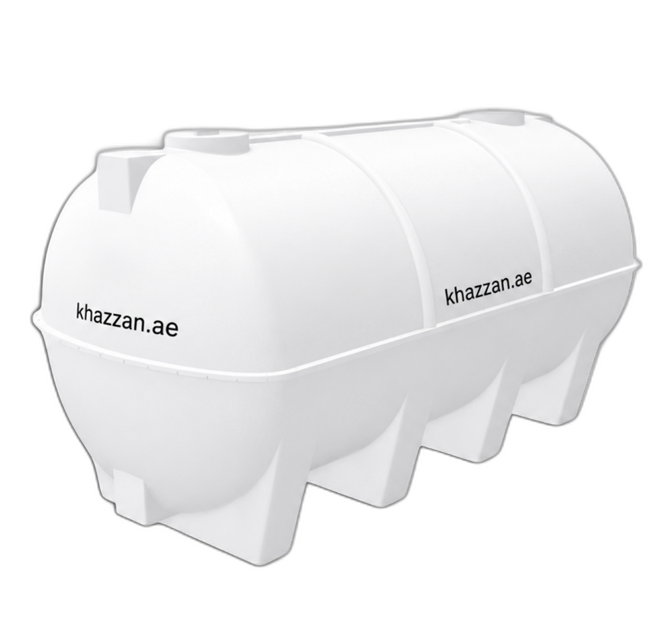
Tank size is the single decision that determines whether your septic system just works or becomes a recurring headache. Go too small and you're looking at overflow and system failure. Go too large and you're paying for capacity that sits mostly empty — which, counter-intuitively, can also hurt the biological process if it's underloaded.
Standard GRP Septic Tank Sizes
| Capacity (US Gallon) | Capacity (Liters) | Typical Use |
|---|---|---|
| 300 USG | 1,135 L | Studio / 1-bedroom apartment |
| 500 USG | 1,893 L | 2-bedroom apartment / small villa |
| 750 USG | 2,839 L | 3-bedroom villa |
| 1,000 USG | 3,785 L | 4-bedroom villa / small commercial |
| 1,500 USG | 5,678 L | Large villa / small labour camp |
| 2,000 USG | 7,570 L | Small commercial building |
| 3,000 USG | 11,356 L | Medium commercial / 20–30 person facility |
| 5,000 USG | 18,927 L | Large commercial / 50 person facility |
| 7,500 USG | 28,390 L | Hotel / large labour camp |
| 10,000 USG | 37,854 L | Large hotel / hospital / industrial |
Working Out What You Need
The standard UAE sizing approach uses 150 litres per person per day, with a minimum two-day retention (three is the safer bet):
Formula: Capacity (L) = 150 L/person × Number of Persons × Retention Days
Worked example — 4-bedroom villa, 6 occupants, 3-day retention:
- 150 × 6 × 3 = 2,700 litres
- Closest standard size: 750 USG (2,839 L)
- Better choice: 1,000 USG (3,785 L), which leaves room for guests and peak-demand days
When in doubt, round up rather than down.
What a Septic Tank Costs in the UAE (2025)
Every GRP septic tank Khazzan.ae supplies carries a rated 5-year service lifespan and a 1-year manufacturer's warranty. Pricing depends on capacity and whether you're going single- or two-chamber:
| Size | Single Chamber (AED) | Two Chamber (AED) |
|---|---|---|
| 300 USG | AED 1,800 – 3,000 | AED 2,500 – 4,000 |
| 500 USG | AED 2,500 – 4,500 | AED 3,500 – 6,000 |
| 1,000 USG | AED 4,500 – 8,000 | AED 6,000 – 10,000 |
| 2,000 USG | AED 8,000 – 14,000 | AED 11,000 – 18,000 |
| 3,000 USG | AED 12,000 – 20,000 | AED 16,000 – 26,000 |
| 5,000 USG | AED 20,000 – 35,000 | AED 28,000 – 45,000 |
| 10,000 USG | AED 38,000 – 65,000 | AED 52,000 – 80,000 |
Get in touch with Khazzan.ae for a current quote against your exact requirement.
What UAE Municipalities Expect
Dubai Municipality
- Only approved materials — GRP is the accepted standard
- A building permit is required before installation begins
- Installation must go through a licensed contractor
- Regular desludging by a DM-licensed vacuum tanker operator is not optional
- Setback distances from boundaries and water sources apply and vary by site
Abu Dhabi (ADSSC)
- Systems must meet Abu Dhabi Sewerage Services Company standards
- GRP is the approved material here as well
- Inspection and pump-out records need to be kept on file
Permits come before digging, not after. A competent contractor will handle this process for you as part of the job.
How Installation Goes, Step by Step
Assess the Site First
Before anyone breaks ground, an engineer should check soil permeability, where the water table sits, required setbacks, and — often overlooked — whether a vacuum tanker can actually reach the tank once it's installed.
Excavate and Bed the Tank
Dig to the required depth, then lay a minimum 300mm bed of clean sand or pea gravel so the tank base sits on uniform, well-supported ground.
Lower It In and Connect the Pipework
Lower the tank using webbing slings only — never chains directly against the shell. Inlet and outlet pipes should connect through flexible couplings to absorb any settlement, with vent pipes installed as specified.
Backfill Carefully
Backfill in layers no thicker than 300mm, using clean sand or an approved granular material, compacting each layer as you go. Keep heavy machinery off the ground directly above the tank.
Test Before Commissioning
Fill with water and check every connection for leaks. Many UAE municipalities won't sign off without a water-tightness test first.
Keeping It Running
How Often to Pump Out
| Property Type | Recommended Frequency |
|---|---|
| Residential villa | Every 1–2 years |
| Small commercial | Every 6–12 months |
| Labour camp | Every 3–6 months |
| Hotel / hospital | Every 1–3 months |
Don't let sludge build up past a third of tank capacity — beyond that point, solids start carrying over into the effluent and the whole system's performance drops off.
What Should Never Go Down the Drain
The bacteria doing the work in your tank are surprisingly easy to kill off. Once they're gone, treatment stops. Keep away from the system: large volumes of antibacterial cleaners, chemical drain openers, anything non-biodegradable (wipes, sanitary products, plastics), bulk cooking oil, paint, solvents, and medications.
Troubleshooting Common Issues
Sewage odour indoors: Run every tap to check P-traps haven't dried out, inspect the vent pipe for blockages, and confirm the outlet is clear.
Drains running slow throughout the property: Almost always means the tank is full. Get a licensed pump-out contractor out immediately and avoid using drains in the meantime.
Sewage surfacing above ground: Treat this as an emergency — restrict access to the area, arrange emergency pump-out, and notify the municipality.
Needing pump-outs more often than expected: Either the tank is undersized for actual load, or something entering the system has disrupted the biological process. Consider upsizing, or take a closer look at what's going down the drains.
Frequently Asked Questions
Q: Do I legally need a septic tank if I'm off the mains sewage network in UAE? A: Yes. UAE health and environmental regulations require every property to properly contain and treat its wastewater. Without a mains connection, a municipality-approved septic tank is mandatory.
Q: What's the realistic lifespan of a GRP septic tank here? A: GRP septic tanks in the UAE carry a rated 5-year service lifespan with a 1-year manufacturer's warranty.
Q: Can effluent go to a soakaway in the UAE? A: In locations with suitable soil and where local regulations permit it, yes. In much of the UAE, groundwater protection rules mean effluent has to be tankered off-site instead — check with your local municipality before assuming a soakaway is an option.
Q: How is a septic tank different from a cesspit? A: A septic tank biologically treats wastewater and releases treated effluent. A cesspit just stores everything with no treatment step, which means far more frequent pump-outs and a less sustainable setup overall.
Q: Does Dubai require a permit for septic tank installation? A: Yes — every septic tank installation in Dubai needs Dubai Municipality approval, and your contractor should be the one filing for it.
For UAE Municipality Certified GRP septic tanks — 300 to 20,000 US Gallon — talk to Khazzan.ae.
Related Resources
- Water Tank UAE — Complete Buyer's Guide
- Water Tank Sizes UAE — Full Size Guide
- Water Tank Price Dubai & UAE 2025
- Water Tank Size Calculator UAE
- Buy Water Tank UAE — Khazzan.ae
📞 Call or WhatsApp: +971509583173 🌐 khazzan.ae 📍 Al Qouz Industrial Area 3, Dubai, UAE 🕐 Monday to Saturday, 8AM – 7PM
Delivering GRP septic tanks across Dubai, Abu Dhabi, Sharjah, Ajman, RAK, Fujairah, and UAQ.