
How to Calculate Water Tank Capacity in Litres and Gallons (With Examples)
Meta Description: How to calculate water tank capacity in litres and gallons for rectangular, round and horizontal tanks, how to measure an existing tank, and how to turn the result into a standard USG tank size.
Target Keyword: How to Calculate Water Tank Capacity Secondary Keywords: how to calculate water tank capacity in litres, how to calculate water tank capacity in gallons, how to measure water tank capacity, water tank volume formula, water tank capacity calculator, tank size litres to gallons
Whether you are checking an old tank, planning a new one or comparing quotes, you need to know how much water a tank really holds. The good news is that the maths is simple. You measure three numbers, multiply, and convert the result to litres or gallons.
This guide shows the formulas for the common tank shapes, works through real examples, and explains why the number on a tank's label is usually a little lower than the full geometric volume.
The Three Conversions You Need
Everything starts from a few fixed relationships:
- 1 cubic metre (m³) = 1,000 litres
- 1 US gallon (USG) = 3.785 litres
- 1 imperial (UK) gallon = 4.546 litres
So to go from litres to US gallons, divide by 3.785. To go from cubic metres to litres, multiply by 1,000. Tank sizes in the UAE are normally quoted in US gallons (USG) with the litre figure beside them, for example 500 USG (1,893 L).
Step 1: Measure in Metres
Measure the inside dimensions if you can, and use metres. If you measure in centimetres, divide by 100. A tank 150 cm wide is 1.5 m wide. Measuring in metres means the answer comes out in cubic metres, which converts to litres in one step.
Measure the water height, not the full tank height, if you want to know how much water is in the tank right now. Measure the full inside height to find total capacity.
Rectangular or Square Tanks
Volume = length × width × height
Example. A rooftop tank measures 2 m long, 1.5 m wide and 1.2 m high inside.
- 2 × 1.5 × 1.2 = 3.6 m³
- 3.6 × 1,000 = 3,600 litres
- 3,600 ÷ 3.785 = about 951 US gallons
Round (Vertical Cylinder) Tanks
Volume = π × radius² × height, where π is about 3.1416 and the radius is half the diameter.
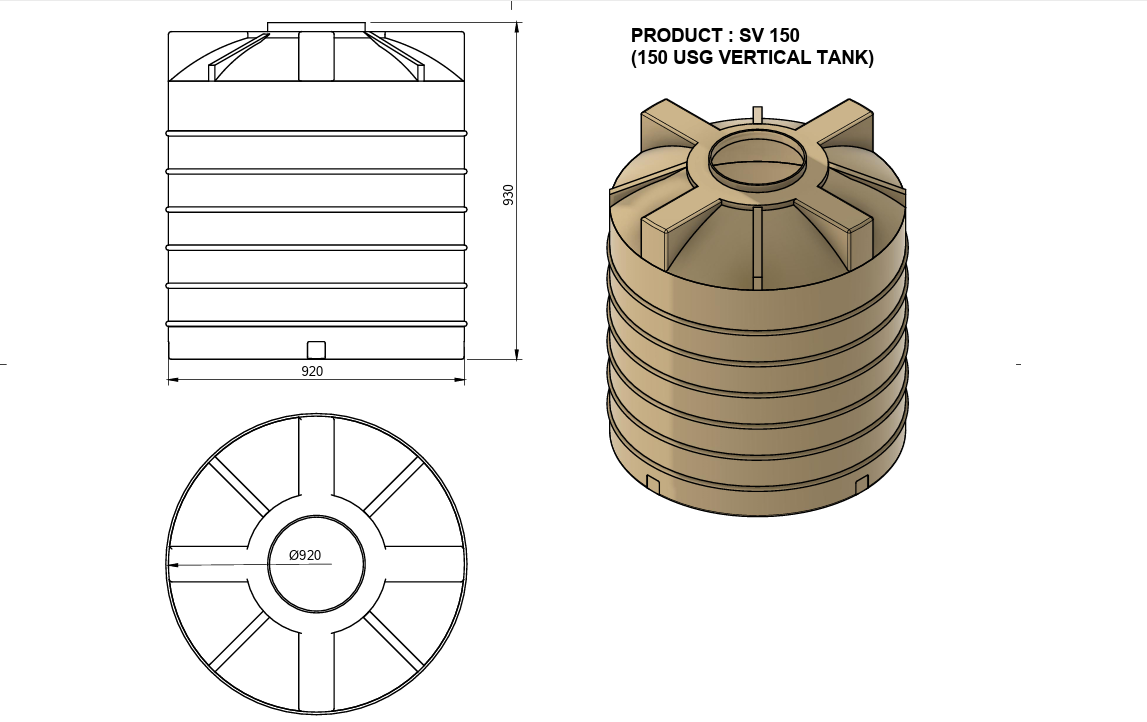
Example. The 150 USG vertical tank on our website is about 0.92 m across and 0.93 m high.
- Radius = 0.92 ÷ 2 = 0.46 m
- 3.1416 × 0.46 × 0.46 × 0.93 = 0.618 m³
- That is about 618 litres, or around 163 US gallons
The product is sold as 150 USG (568 litres). The difference is explained in the section below on why the label number is lower.
Horizontal (Lying) Cylinder Tanks
For a full horizontal cylinder the formula is the same as for a vertical one, but you use the length in place of the height:
Volume = π × radius² × length
Horizontal tanks usually have domed ends and moulded feet, so the geometric result is slightly higher than the usable capacity. Use it as an upper bound and compare it with the stated size.
Working out how much water is in a horizontal tank is harder, because the volume does not rise in a straight line with the water depth. The tank holds much less than half its volume when the water is at a quarter of the height, and more than half when it is above the middle. For accurate readings use the manufacturer's dip chart, a level gauge, or a flow meter on the inlet.
Why the Label Number Is Lower Than Your Calculation
If you work out the volume from the outside dimensions you will almost always get more than the label says. The usual reasons:
- Wall thickness. Outside measurements include the wall. Inside measurements are smaller.
- Air space at the top. A tank is never filled to the brim. The float valve and overflow sit below the top, and the lid area adds extra height that holds no water.
- Ribs, domes and feet. Moulded features take up space in the shape.
Always treat the stated nominal capacity as the working figure for design, and use your own calculation only to check that it is the right order of size.
How to Measure the Capacity of an Existing Tank
When the tank has no label, or you doubt it, you have three options:
- Measure and calculate using the formulas above, then reduce the result by about 5 to 10 percent for walls and headroom.
- Fill and count. Use a flow meter or a bucket of known size while you fill it from empty to the overflow level.
- Check the markings. Many moulded tanks have the capacity printed or embossed on the body or a plate.
Matching the Result to a Standard Tank Size
Once you know what you need in litres, pick the next standard size up. Common sizes and their capacity:
| Size (USG) | Approx. litres |
|---|---|
| 100 USG | 379 L |
| 150 USG | 568 L |
| 200 USG | 757 L |
| 250 USG | 946 L |
| 300 USG | 1,135 L |
| 500 USG | 1,893 L |
| 1,000 USG | 3,785 L |
| 2,000 USG | 7,571 L |
| 5,000 USG | 18,927 L |
How Much Capacity Do You Actually Need?
Working out the tank is only half the question. The other half is how much water you use. A simple method is:
- Estimate daily use for the people or process on the supply.
- Decide how many days of reserve you want if the supply fails.
- Multiply, then add a safety margin.
Our water tank size calculator does this for homes and buildings, and the water tank sizes guide lists the full range. For installation allowances, see the dimensions on each size's page, such as the 150 USG vertical tank and the 1,250 USG horizontal tank.
Frequently Asked Questions
How do I calculate water tank capacity in litres?
Multiply length by width by height in metres to get cubic metres, then multiply by 1,000. For a round tank use π × radius² × height. A 2 m by 1.5 m by 1.2 m tank holds 3,600 litres.
How do I calculate water tank capacity in gallons?
Work out the volume in litres first, then divide by 3.785 for US gallons or by 4.546 for imperial gallons. 3,600 litres is about 951 US gallons.
How do I measure water tank capacity if there is no label?
Measure the inside dimensions and calculate, then deduct 5 to 10 percent for wall thickness and headroom. Or fill the tank from empty through a flow meter.
What is the formula for a round water tank?
Volume = π × radius × radius × height. The radius is half the diameter. Use metres and multiply by 1,000 to get litres.
Why is the calculated volume higher than the tank's rated size?
Because the calculation does not allow for the wall thickness, the air space at the top, and the ribs and feet of the moulded shape. The rated size is the usable working capacity.
How many litres are in a 500 gallon tank?
A 500 USG tank holds about 1,893 litres.
How do I work out how much water is left in a horizontal tank?
The volume does not change in proportion to the depth. Use a dip chart, a level gauge or a flow meter instead of estimating by eye.
Related Resources
- Water Tank Size Calculator
- Water Tank Sizes in the UAE: A Full Reference Guide
- Water Tank Buying Guide UAE
- Horizontal Water Tanks UAE
- Vertical Water Tanks UAE
- Water Storage Tanks UAE
📞 Call or WhatsApp: +971509583173 ✉️ Email: khazzanae@gmail.com 🌐 khazzan.ae 📍 Al Qouz Industrial Area 3, Dubai, UAE 🕐 Monday to Saturday, 8AM to 7PM