
GRP Water Tank in the UAE: From Factory to Site, Delivery and Installation Guide
Meta Description: GRP water tank delivery and installation in UAE: how tanks are transported, what the site needs, base preparation, offloading, connections and the first fill, with real photos from Khazzan deliveries.
Target Keyword: GRP Water Tank Secondary Keywords: grp water tank uae, grp water tank delivery dubai, grp water tank installation, fiberglass water tank uae, grp tank supplier dubai, vertical grp water tank
Buying a GRP water tank is only half the job. The other half is getting a tank that can be 2 to 3 metres wide from the factory yard to your site, lifting it into place, and connecting it correctly. Most problems with new tanks, such as leaks at fittings, cracked bases and tanks that will not fit through a gate, come from skipping this half.
This guide walks through what a delivery and installation actually involves, using photos from real Khazzan deliveries.
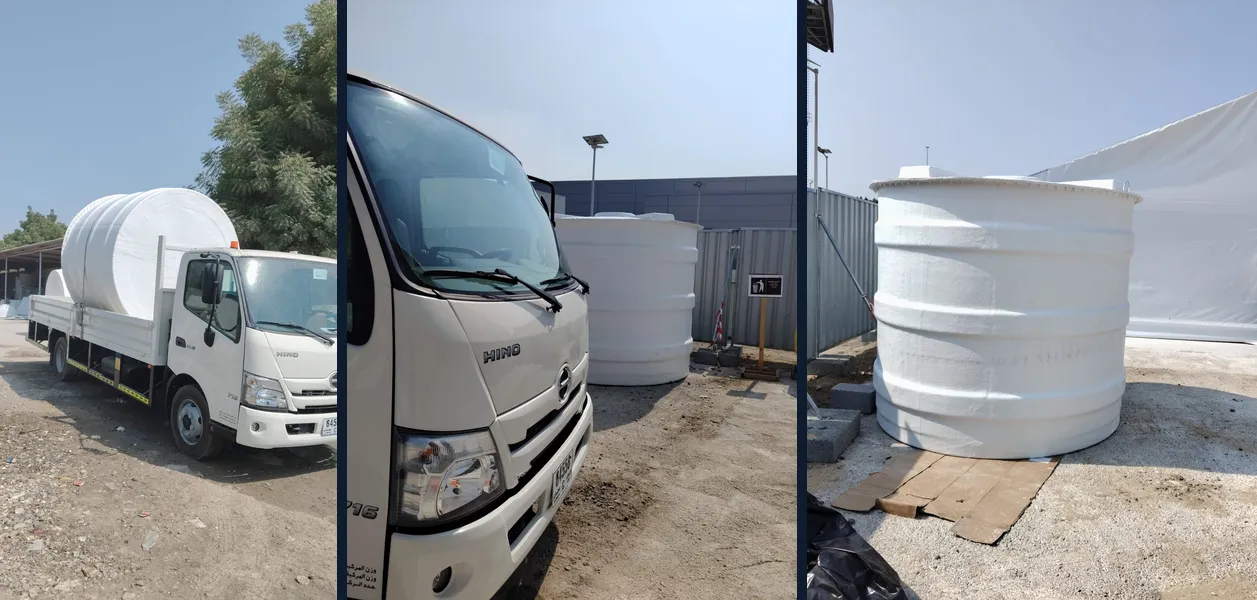
What a GRP Water Tank Is, in Brief
GRP stands for glass reinforced plastic, often called fiberglass. The tank wall is built up in layers of glass fibre and resin, finished with a smooth food-grade inner surface for potable water. Unlike a rotationally moulded plastic tank, a GRP tank is rigid, does not bulge as it fills, and is made in sizes that run well beyond what plastic tanks reach.
GRP tanks come in two shapes:
- Horizontal tanks lie on their side and sit low, which suits plant rooms, ground level installations and anywhere height is limited.
- Vertical tanks stand upright with a ribbed wall and take up less floor space for the same capacity.
If you are still choosing a size, start with the water tank size calculator and browse the GRP fiberglass water tank range, where every size has its own dimensions page.
Step 1: Check the Route Before the Tank Ships
A GRP tank cannot be folded or squeezed. Before ordering, measure the whole path from the road to the final position:
- Gate and access width. Compare the tank's overall width and height with the narrowest gate, door or passage. Dimensions for each size are on the product pages. For example, a 2,000 USG horizontal tank is about 278 cm long, 237 cm wide and 218 cm high.
- Overhead clearance. Cables, trees, signs and building overhangs matter once the tank is loaded on a truck.
- Turning space. The delivery truck needs room to reach the tank position, or to stop close enough for a crane or lifting equipment.
- Ground strength. A loaded truck and a lifting machine both need firm ground. Soft or freshly filled areas cause delays.
If the route is too tight for a complete tank, a sectional GRP panel tank is built on site from bolted panels and avoids the problem entirely.
Step 2: How the Tank Travels
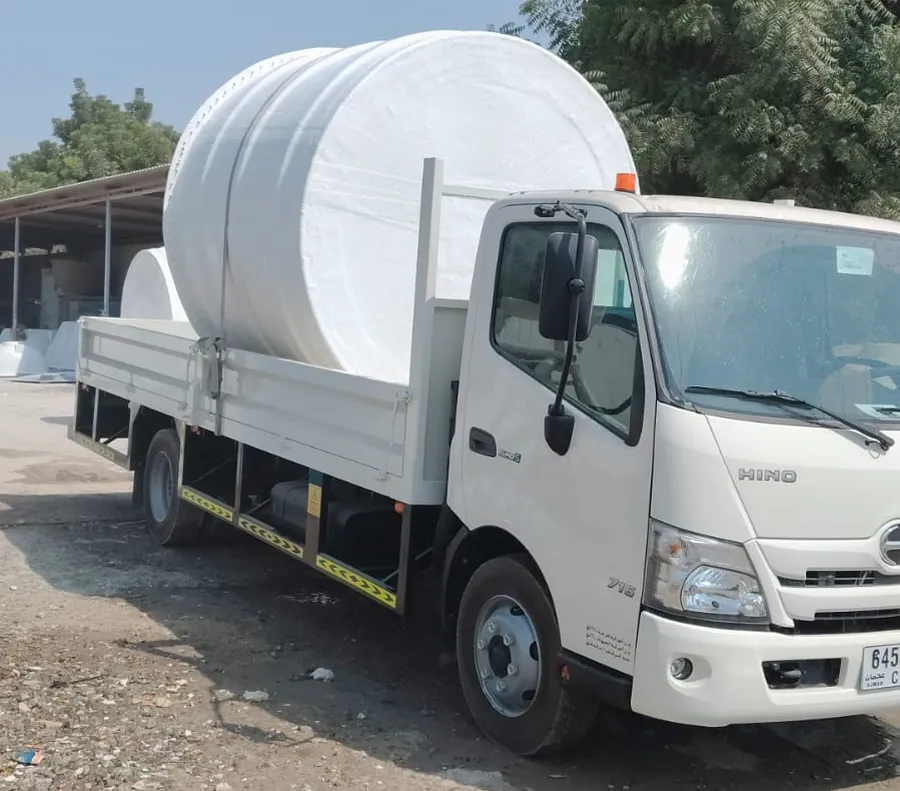
Tanks are delivered on a flatbed truck, strapped down and protected against rubbing. The photo below shows a large GRP tank loaded on its side on a Khazzan delivery truck, wrapped for protection and secured with straps across the body.
What matters during transport:
- Straps over padding, never bare chains. Hard contact points can scratch or mark the surface.
- Support under the tank. The body should rest on a stable base so the load is spread, not carried on a single edge.
- Loaded dimensions. The width of the tank sets the width of the load. Larger sizes need route planning, and this is why we ask for the site location and access details at the time of the order.
Step 3: Prepare the Base
The base is the part owners most often underestimate. A full tank is heavy: 1,000 litres of water weighs one tonne, so a 10,000 litre tank carries about 10 tonnes of water plus its own weight.
For a ground level tank:
- Use a level, flat concrete slab or a compacted, levelled bed that is firm across the full footprint.
- Check the level in both directions. A tank on a sloping base loads one side more than the other.
- Keep the base clean of stones and sharp debris, which can point-load the shell.
- Allow working space around the tank, ideally at least 60 cm, so fittings and valves can be reached and the tank can be inspected and cleaned later.
For a rooftop or podium installation, the structure must be confirmed by an engineer to carry the full weight of the filled tank. Never rely on an assumption here.
Step 4: Offloading and Placement
Small tanks can be moved by hand with enough people. Larger GRP tanks are lifted or rolled off with the right equipment:
- Use soft slings on the proper lifting positions, not ropes through fittings or around the neck.
- Keep the tank clear of the ground while it is moved, and do not drag it. Dragging damages the underside.
- Place a protective layer such as cardboard or a sheet under the tank on rough ground so the shell does not scrape the surface while it is being positioned. You can see this in the site photo below, where the finished vertical tank sits on a prepared base with protective sheeting still under the edge.
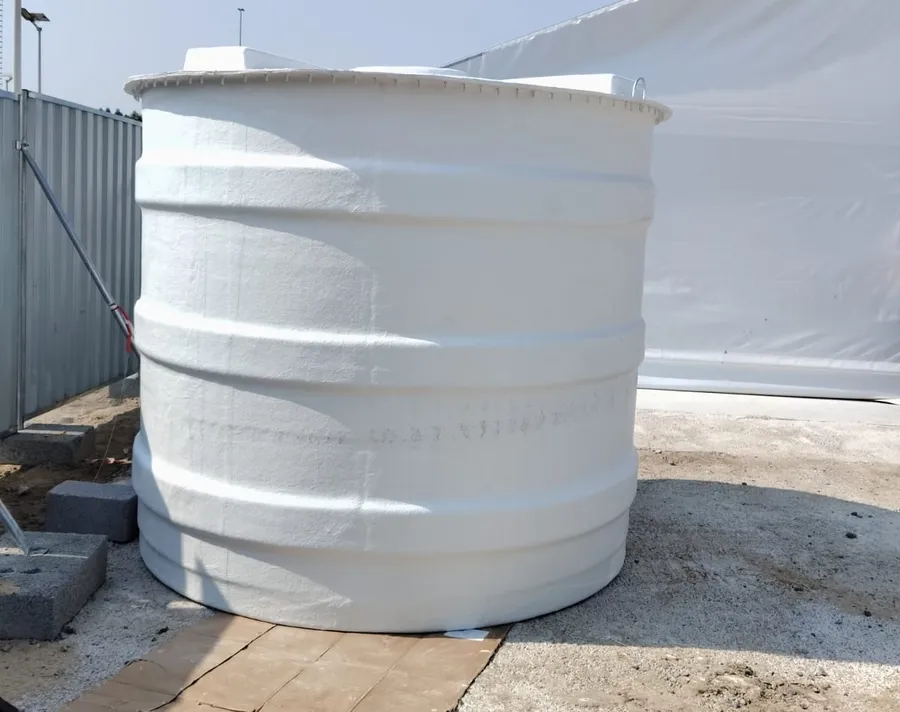
The ribbed wall of a vertical GRP tank is not decoration. The ribs stiffen the cylinder so the wall holds its shape as the water load pushes outward.
Step 5: Pipework and Fittings
Once the tank is in position and level, the connections go on. A typical GRP tank has:
- An inlet from the supply, usually with a float valve or level control so the tank does not overflow.
- An outlet with an isolation valve so the tank can be shut off for maintenance.
- An overflow and a vent of the right size, routed away safely. A blocked vent is a common reason tanks look as if they are collapsing or struggling to fill.
- A drain or washout at the lowest point, which makes cleaning much easier.
- A manhole cover that closes tightly to keep dust, insects and light out.
Use flexible connectors where the pipework meets the tank so small movements and temperature changes do not stress the shell. Support the pipes independently. Hanging the weight of a pipe run on the tank connection is a frequent cause of cracks around fittings.
Step 6: First Fill, Test and Disinfection
Do not skip the first fill. A short commissioning routine saves problems later:
- Fill slowly to a quarter, then check the level and look at every fitting for seepage.
- Continue to full and leave it for several hours. Recheck the base and the connections.
- Wash and disinfect before the water goes into service, especially for potable storage. See our guide on water tank cleaning and maintenance for the process.
- Test the float valve and overflow so you know they work before the tank is relied on.
Why Choose GRP for Large Storage in the UAE
- Heat and UV. The UAE sun is hard on materials. GRP is stable under strong UV and high temperatures and does not soften the way some plastics can.
- Size range. GRP tanks go from small domestic sizes up to tens of thousands of gallons in one piece.
- Long service life. With a sound base and correct fittings, a GRP tank gives many years of service.
- Hygiene. The smooth inner surface does not hold onto deposits and is easy to clean.
- Custom options. Ports, manholes and sizes can be arranged around the site.
For a full comparison with plastic, see GRP vs polyethylene water tank.
Common Mistakes to Avoid
- Ordering before measuring the gate and route.
- Placing the tank on an uneven or unprepared base.
- Dragging the tank across the ground into position.
- Fixing rigid pipes straight to the tank with no support or flexible joint.
- Undersized or blocked vent and overflow.
- Using the tank before it has been flushed and disinfected.
Frequently Asked Questions
Can a GRP water tank be delivered anywhere in the UAE?
Yes. Khazzan delivers GRP water tanks across Dubai, Abu Dhabi, Sharjah and the other emirates. Delivery cost depends on tank size and distance, see delivery pricing. Share your site location and access details on WhatsApp so the right vehicle and offloading method are arranged.
How long does installation of a GRP water tank take?
Placing a tank on a ready base is usually a matter of hours. The longer part is preparing the base and the pipework, so have the slab and connection points ready before the tank arrives.
Do I need a crane to install a GRP water tank?
Not always. Smaller tanks can be placed by hand or with a forklift. Larger tanks, and any tank going onto a roof or podium, need lifting equipment. Tell us the position and the height at the time of order.
Can a GRP water tank go on a rooftop?
Yes, as long as the roof structure is checked by an engineer for the full weight of the filled tank, and the tank can be lifted to the roof. If a full tank cannot be lifted, a sectional panel tank can be assembled on the roof.
What base does a GRP water tank need?
A flat, level, firm base that supports the full footprint, normally a concrete slab at ground level. The base must also be free of sharp debris.
How big can a GRP water tank be?
One-piece GRP water tanks are available in sizes from a few hundred gallons up to 20,000 USG and beyond. Above that, sectional panel tanks are the practical choice. See the GRP tank sizes for dimensions of each model.
How often should a GRP water tank be cleaned?
At least once or twice a year for potable storage, and more often if the water quality changes. Khazzan also offers water tank cleaning in Dubai and across the UAE.
Related Resources
- GRP Fiberglass Water Tanks: Full Range and Sizes
- GRP Water Tanks in the UAE: Sizing, Cost and Why They're the Default for Big Projects
- GRP Fiberglass Tanks in the UAE: A Practical Buyer's Guide
- GRP Water Tank Accessories: Lining, Ladders and Fittings
- Delivery Pricing
- Water Storage Tanks UAE
📞 Call or WhatsApp: +971509583173 ✉️ Email: khazzanae@gmail.com 🌐 khazzan.ae 📍 Al Qouz Industrial Area 3, Dubai, UAE 🕐 Monday to Saturday, 8AM to 7PM